


How to Design a Shrink Sleeve Label – Shrink Sleeve Packaging Design Tips
- Sep, 08 2011
- By Clay
- Package Design
- 45 comments
Shrink Sleeve Packaging is Super Sexy – Learn How the Shrink Sleeving Process Works with This Shrink Sleeve Tutorial
First Some Good News
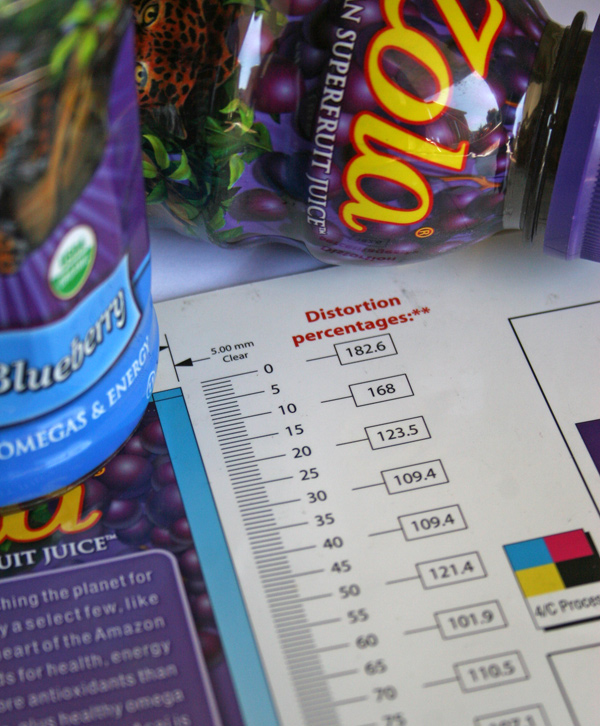
You don’t need to add the distortion percentages on a shrink label yourself. You just design it the regular non-distorted way according to the dieline and the printing company will add the distortion to your design to match the curvature of the container. They have special packaging software for doing that. Really, they do. No lie.
I found this out the long way back in 2006 when I received a blank dieline from OSIO. I was working on the new Zola bottles. They were transitioning away from juice boxes at the time and were moving to shrink sleeves. Although my design is not in production anymore, they continue to use shrink sleeve technology to this day.
Along one side of the dieline was a list of millimeter markers and next to each one it specified the percentage of distortion needed. Confused on how I was supposed to do that, especially on a design that contain hundreds of round acai berries near the top of the bottle where it narrows the most, I called up the production department.
“Oh, you don’t have to do the distortion. We do that for you. That’s just for our information. It also let’s you know that it’s best to keep anything that could suffer from the natural effects of shrink sleeving, like tiny text or geometric shapes, away from the part that will shrink the most.”
“Whew, that’s a relief!”
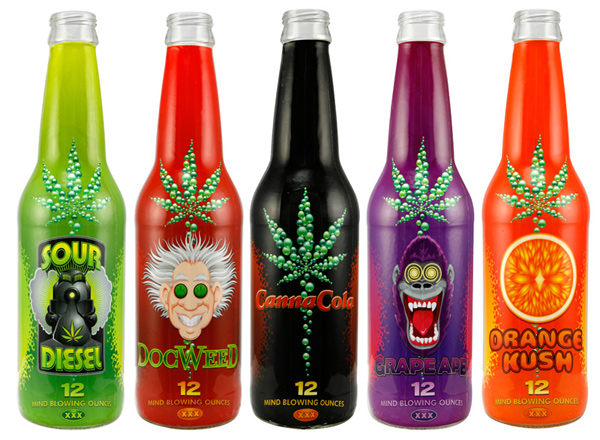
Since then I’ve done a variety of shrink sleeve labels so I’m making this little tutorial that walks you through the process. For this example I’m going to use the shrink sleeved Canna Cola bottles I designed and take you through it from beginning to end.
Decide if Shrink Sleeve Packaging is Right For You
This comes down to cost and appropriateness. Cost depends on your margins. Shrink sleeves are more expensive to print and apply. However the shelf appeal is undeniable. Shrink sleeving is sexy and consumers respond accordingly. If you want to make a big splash, then shrink sleeving may be worth it even at the cost of slimmer margins- especially in the beginning when your print runs are lower.
Next is appropriateness. Would you shrink sleeve pickles? Probably not as people like to see the pickles. Seeing the size, cut, color and shape of the pickle is part of the decision process. However yogurt, fruit drinks, smoothies, supplements, and other foods that are usually in opaque containers are good candidates for shrink sleeving.
Picking The Container
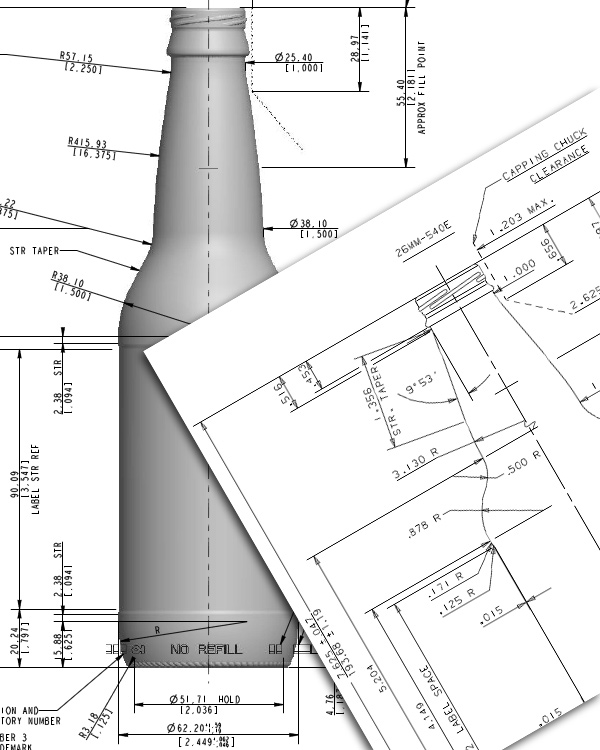
Before you design anything, you need to choose your container. Without that you have know idea what you’ll be designing to. The manufacturer will have spec sheets for their containers whether they are bottles, jars, tubes, or tubs. Sometimes it’s an outline of the container with measurements and sometimes it looks like a CAD drawing. Either way you need this file and some physical samples to test with. Here is an example of glass bottle spec files so you can get a good idea of what you’ll need.
Here’s a few top manufactures of containers:
One of the largest glass container companies in the US
Owens-Illinois Inc. is probably the biggest glass manufacturer in the US and possibly the world.
Always a great place to start to find suppliers for plastic bottles, glass bottles, and plastic jars
Huge selection of plastic containers for all product types.
I guess the name says it all.
Send a Sample to The Printer
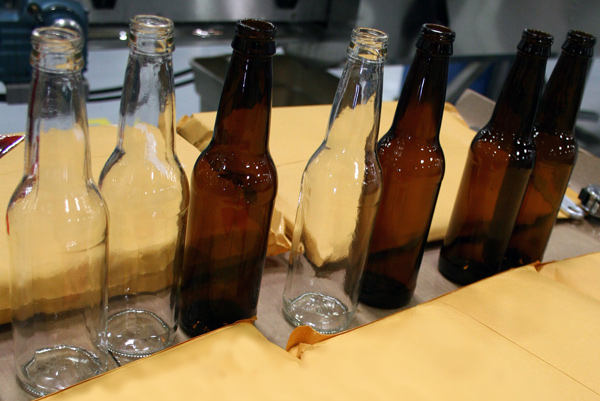
The printer will want the spec sheets AND a sample of the container. This way they can double check everything. They will also use the container for testing.
Not everyone does shrink sleeving and these days you can get into very short runs with digital printing. You pay a premium per label over flexo or gravure but the set up charges are very low and mixing SKUs is very easy. Plus, with flexo you’re looking at entry level print runs of 25k per SKU just to get in the game. However, with digital you can print a couple of hundred if you like, you just pay a premium price per label. With flexo and gravure, that’s not an option at all.
Here’s a few shrink sleeve printers I’ve worked with:
Fantastic digital labels. Perfect for short runs. They can also do flexo and gravure print runs starting in the 25k per SKU range.
Good choice for gravure printing. You’ll need big print runs in the 50k plus range per SKU to take advantage of their services
Digital and flexo shrink sleeve printing.
I haven’t used this company personally but based one what I know, they look like a top notch company.
Design Your Label According to The Dieline
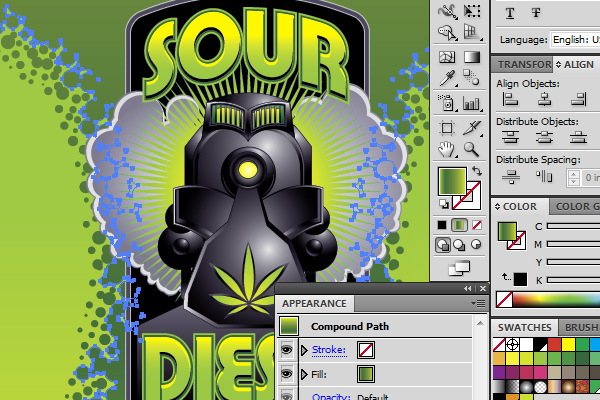
The printer will provide a dieline. If they didn’t, then ask them for one. For the Canna Cola Bottles I actually made my own just by wrapping a piece of paper around the bottle and then marking the overlap and then measuring it. Not the recommended way of doing it but it was spot on when we ran the tests.
The reason you can get by with an on-the-fly method of dieline creation is that no matter what the shape of the container, you will still be designing to a rectangular space. It’s no different than designing a flat label. Before sleeving, each label is cut off from the master print roll and then rolled into a tube and then seamed. The tube is placed over the top of the container and then sent though the tunnel. It’s the shrinking that creates all the great contours, not your dieline.
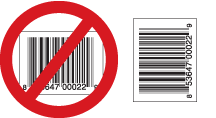 Note on Barcodes:
On a shrink sleeved label, place the barcode vertically (turned 90 degrees on it’s side).
This ensures that they will be scannable after they are shrunk.
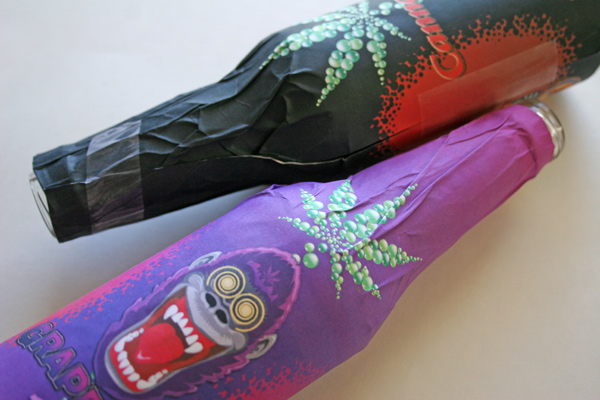
Print Out and Mock Up The Design
It’s not the most pretty method, but print out your sleeve design and then just hand wrap it around the container. This will give you a decent feel of how the design works three dimensionally. Sure, it’s a wrinkled mess, but it’s good enough for judging balance, flow, composition, readability and the placement of key label components.
True, you could do a 3-D mock up in Illustrator but monitors are deceiving. We’re so used to zooming in that we quickly lose touch with how our design will feel in actual size. On the monitor your designs ALWAYS feel bigger than they really are and the text ALWAYS looks bigger and more legible.
However, the customer won’t be zooming in at 600% to read the label. They won’t see it on a brilliant LED display. They will see it on a shelf surrounded by hundreds of other products all trying to get their attention. This is why you need to do full scale hard prototypes. It’s the only thing that will simulate how it will actually be perceived in the marketplace.
Approve the Proofs
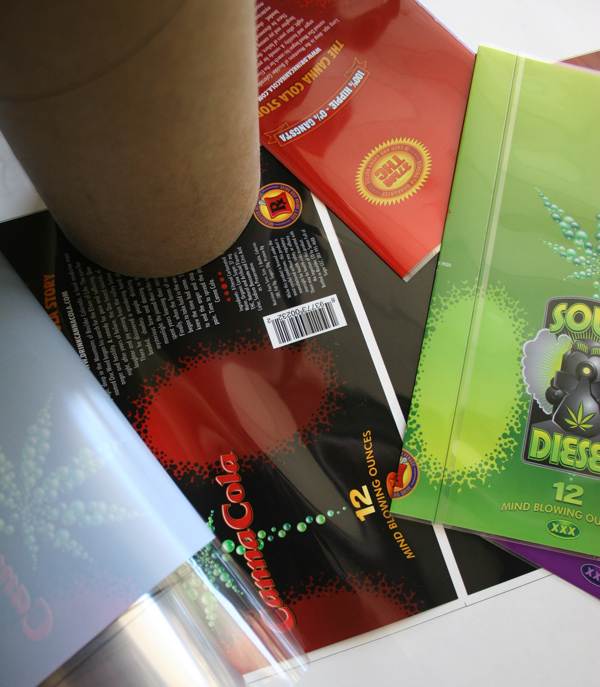
The printer will send you some proofs. Either digital or print. If it’s good, then approve it. However, only sign off on the visual part, make sure your client signs off on the text. Even though the labels will ultimately be shrunk around the container, the sleeves themselves will be cut and seamed into straight cylinders, just like a tube. Most likely your first proof will be flat and not cut and seamed. The proofs will look funny because they will already have the distortion factored in. So parts that will have a large amount of shrinkage will be stretched horizontally while low distortion areas will look almost normal.
Run Some Sample Labels and Do a Shrink Test
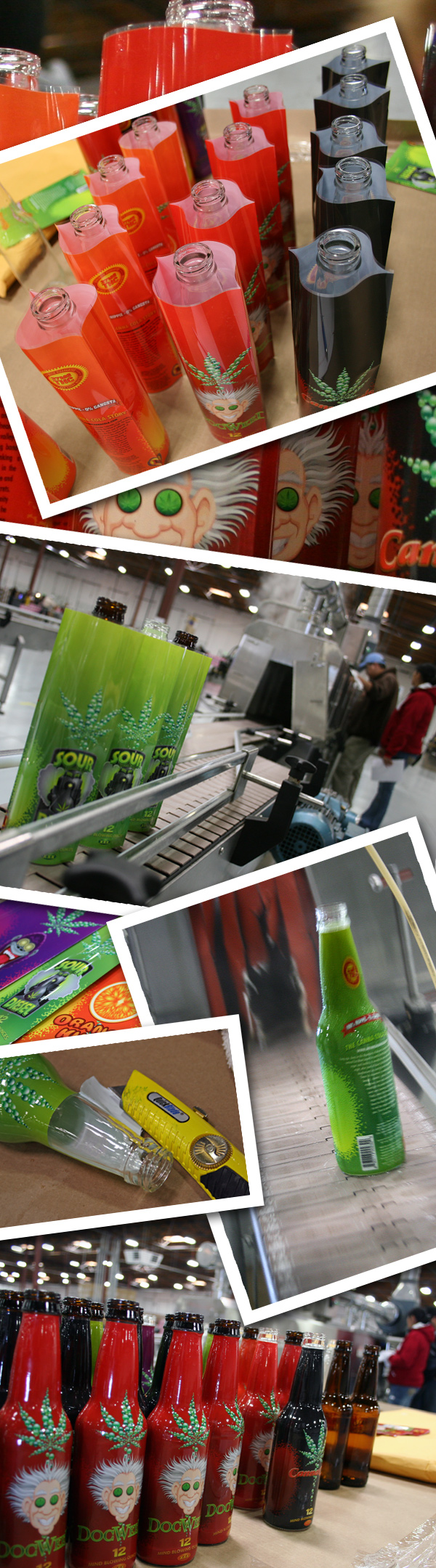
You may or may not be there for this step. For the Canna Cola labels I went to the packaging plant myself and ran the test. We ran dozens of bottles and tested all the flavors. We tweaked the settings on the shrink tunnel as we dialed in the best speed and heat level. A shrink tunnel is basically a conveyor belt that runs though a metal box that is filled with steam jets. The steam shrinks the label to the container. It’s kind of magical to see it first hand but it needs to be dialed in to your specific label and container.
We had hundreds of sample labels that were pre-seamed (cut from the original roll and seamed together into tubes) but we had a limited number of bottles. So labels that shrunk poorly were cut off the bottle so we could run another label on it.
Some shrink tunnels use steam, and some use a combination of infrared and hot air to shrink the labels. Which method you use depends on application. For full body applications, and when you want high quality, distortion-free graphics, steam tunnels are best. Steam is also best for pressurized containers or products with high flammability. For tamper evident labels, a hot air convection tunnel does an excellent job. If your neckbands are very dark in color, radiant infrared is an excellent choice because dark material absorbs heat.
Rework the Label if Necessary and Repeat
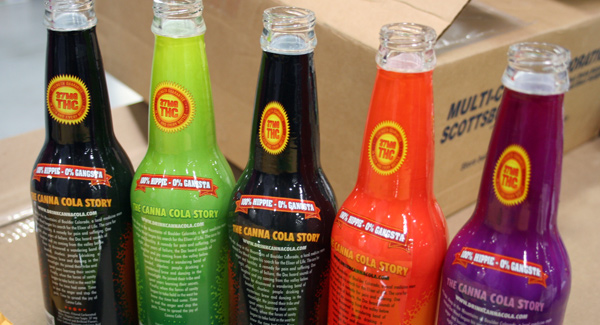
After you run your tests you many notice problem areas. On Canna Cola it was the sunburst THC decal on the neck. This was placed on a very high distortion area so the decal came out more oval then circular. Rather than have a large amount of rejects we opted to drop the circle.
This is why it’s best to keep geometric or highly symmetrical shapes off high distortion areas. Asymmetrical or organic shapes can hide distortion flaws much better.
Run the Final Labels and Bask in the Glory of Your New Designs
Shrink sleeve packaging is hot, hot, hot. Even though it’s increasing in popularity, it’s still a novelty in the general market. And because it’s more complicated and expensive that a paper label, or printing a couple of spots on aluminum cans or plastic tubs, I suspect it will remain a premium look for quite some time.
Need a Killer Shrink Sleeve Package Design? Call 831-566-3046 or email me if you’d like to discuss what great branding can do for your product packaging design.
Additional Reading:
Nice white paper that explains how shrink sleeving calculations are achieved
Nice layperson’s article on the shrink sleeving proccess
Learn about shrink tunnel technology
Videos:
This is a steam shrink tunnel in action.
This is most likely an air or infrared shrink tunnel for a tamper evident label application.
Here’s a nice video of shrink machine money shots. If you like manufacturing as much I do you’ll dig this.
More shrink packaging porn with a killer English host
File Under: Shrink Sleeve Packaging Design Tutorial


Germano
Hello, I am an Italian designer …
I banged my head against the wall a thousand times for detailed technical information on packaging projects, I finally found your blog definitely the best you can find around. The planning stages are very useful, it’s the small details that make a difference, keep it up.
Brad M
Great article. I also wanted to point out a couple things that apply to flexo and gravure printing, digital not so much. Designers, remember that you are limited to generally 10 plates(colors) and that depending on the contents of the beverage you may need an additional pass of white. If you add a varnish(i.e. matte) then that also will take up a plate. So, even before you begin your design you may be down to 7 colors. Next, CMYK is great for images but use solid colors for copy(text). Also, utilize overprinting and knockout when possible. For example, on CannaCola, Clay used knockout text on the back panel; the black was knocked out to reveal the white. In the future, any text changes to the back panel will result in only one plate change. Not only that but the text will come out much crisper because there are no colors being mixed, its only black; so no registration issues.
Again, awesome artwork and great article.
Ranjan
Matt Vanish: The size of Matt is size of sleeveX2 minus 1 mm. Meaning if the sleeve size is W85mm, then matt print width is 170mm – 1mm = 169mm. Matt should be printed over the transparent seam area.
isaac vas
Reading your blog was a great help. Saved a lot of trouble for us. We are in the process of designing a label for Club Soda….and we asked our designer team to first go through your write up…Thanks for all those tips!
Up & Comer
I think your absolutely right about the full bottle wrap. It’s f***in’ sexy … I have a great idea for either an indie brewery or even a corporate co. but I need to find out where to start w/ the shrink wraps… Who,, What, Where, When, and How would be the quickest way to upload an image to a manufacturer and have a wrap in my hands…
Clay Butler
Slow down there. There is no manufacturer to upload an image to. You can’t skip the steps in this tutorial. It really is that complicated. Just sourcing your bottles is a job in itself. There are only two bottle manufacturers that make beer type bottles and you may have to buy them in raw pallets of 4000 count and have them delivered by freight to a loading doc. If you are starting from scratch expect to spend at least six months just getting to the point where you are ready to print and shrink. That’s assuming everything goes perfectly.
Scott
Perfect, I need this mini tutorial as I have beer can wrap to do. thank you for taking the time to write this article.
Clay Butler
You’re welcome.
Richard
Do you have any suggestions on how to make shrink wrap labels at home on a printer for prototyping?
Clay Butler
You won’t be able to do it. You need blank shrink film and then you need the software to add the distortion percentages. You’ll also need an inkjet that can print on the film and be permanent. If you just want to see how it all fits for yourself, just print on paper and then wrap it around the container. If it’s for a presentation then just do a Photoshop simulation. If you need a few prototypes then check out my page of prototyping resources. Trying to do it yourself is not a good idea. You could also order a short run of labels from a digital shrink sleeve printer and then use a blow dryer to shrink them on.
David Giusti
This may be off topic but is there a flat no gloss shrink wrap material?
Thanks,
Dave
Clay Butler
Yes, you can use a matte finish shrink sleeve film.
Carl Hagberg
Hi there Clay i was just wondering as im about to sleeve some bottles my self, if the bottle allready has been filled with the liquid dose the liquid react when the bottle is heated ? and how many degrees dose the bottle get heated up to ?
Clay Butler
It get’s pretty hot in a steam tunnel. Just think about what’s it’s like to put your hand over steam, coming off a boiling pot. With shrink sleeves you often shrink first and then bottle. It really depends. Some things, like full coverage over the top or a safety seal, have to be shrunk afterward.
Aashit C.Rajgor
Hi, I work as a freelancer in India and i enjoyed your brief
on shrink and shrink has always adored me. I have one
simple query do plastic Shrink film quality has to vary from shape of the material also is it possible for economical
printing on digital for large scale
Clay Butler
Sure, digital printing can be very economical but so much depends on the wholesale cost of the product. If you’re selling a twelve oz bottle for seventy-five cents wholesale, shrink sleeving digital labels will eat into that pretty heavily.
Akash
Hi, i am looking for a sleeving solution for a printed aluminum cans which will be used in deo filling. Do you have any idea if shrinking is possible in shaped can?
Clay Butler
Just about anything can be sleeved. It’s a very forgiving medium.
Matt
Great read. Thanks!
I’m working with a 1-off bottle (to be mass produced later). It’s literally the injection mold I’m holding so it’s super heavy. What do you do in the case of this, such that there are no specs (I’ve literally just been asked to create a ‘wrap’. They mentioned shrinking it, though, there’s another catch. This thing has a handle. Which means there would need to be a cut-out in the sleeve. Is THAT even possible?
Thanks!
Clay Butler
Yes, you could have a cut out for the handle. But here’s the inherent problem with that. That sleeve has to go on perfectly each time – right over the handle. I would review that with your co-packer first to see if that’s practical or even possible.
As for specs. Just wrap a piece of paper around it and mark off the circumference and height. It will be close enough for now. The label printer will double check the specs and you’ll be doing some test wraps first anyway before letting the whole production run.
Tom Manning
HI Clay
Very well put together article, the interweb can be a nest of dead-ends and then something succinct like this is written and published, a breath of fresh air.
We’re on a slightly different trip, trying to mock-up shrinkwrap products that don’t exist yet for TV commercials. Been a frustrating journey. I’m about to try screen-printing onto blank shrinkwrap (Digital printing cant get the pantone colours) so will be stumbling through the brambles of deformation myself. should work right?
Clay Butler
Well, better than nothing I suppose. But I would just go digital. There’s no reason digital can’t nail those Pantone colors.
Erik
Stellar article Clay. Well done. Ever see anyone able to hit the printed sleeve with a perforation die set to enable a pull tab to be incorporated on the finished product? Like a zipper?
Clay Butler
Yes, it’s a simple procedure on the printer’s end to do the perforation.
Doug
Aren’t perforations in shrink added during the sleeve operation rather than at the printer? or both?
Nice blog.
Nafise
Hi Clay
It was a helpful article. Do you think or do you have any idea for using shrinking for tin cans? for example tuna cans? Does it slip out of can because it is flat?
Clay Butler
As long as the label has a little lip on it so it grips the rim you’ll be good. Shrink sleeves don’t necessarily need to grip the lip to stray on as they form a very tight seal regardless, but it’s a good idea on a container that is completely straight on the sides.
Paresh
Thank you for sharing your work and experience. This was a useful article. I was looking for information about the distortion and you made it clear in the first paragraph itself
Clay Butler
You’re welcome. I put it in the beginning because I assumed that would probably be the number one question.
ray
looking at shrink wrapping my hockey stick instead of a paint scheme which takes time to do, or stickers which look rough and feel rough as well.
I know its a big item so I dont know if it is even possible for a company to make it.
Your article rocks.
thanks
Ray
Will Armenteros
I am an electrician and am always wearing out the rubber
grips on my hand tools. I was planning on covering them
with heat shrink when I stumbled across your
website. Instead of just plain heat shrink on my
handles, I was wondering if there was a way to print custom
graphics on to heat shrink ,the same way you print on to the
plastic shrink sleeves? please let me know if this
is even possible. I would really like to design my own custom tool handle grips.
Clay Butler
Yes, it is possible. But you would be using a totally different kind of film. Something thicker and with some grip.
Allan Stevan
I am using a automated Body sleeving machine. the container are glossy white in shape. During conveying of the Jar their is black trace of carbon found on the bottom of the container, this is because of the carbon discharge from the SS slat belts. How do I avoid the same? & i have tried using other material belts like delrine slates as shown in one of the above video. This shrink tunnel works at a temp of 200 to 250dgr. this make the delrin or slat chain to melt
Clay Butler
I have no idea. My specialty is packaging design. This is out of my area of expertise.
Brian
I’m up in the Bay Area doing beverage manufacturing looking in to shrink sleeves for some new products. Have you worked with any companies in Northern California that bottles can be sent to their facility just for labeling? We don’t do enough volume to buy a steam tunnel, but shrink sleeves seem like our only option with the new project. And props for all the great info!
Clay Butler
Try Pflug in Stockton (http://www.pflugpackaging.com/) They can do that.
Joaquim Rodriguez
Hi, how would you make a prototype if you had to seem and shrink on a lab out of a printed 45PETG reel? How do you consider would be the best way to perform the seem and then shrink on a plastic bottle? Technical specs?
Thank you,
Clay Butler
That’s going to be tricky. An impulse sealer could easily burn through the material. Maybe super glue.
Matt
Double sided PET tape works great for me. Cut to the length of the sleeve, only need about 1/4″ or less. Apply to one edge, fold over, crease, then apply some Crystal Clear tape over the “seam” when shrinking so it doesn’t bust, remove the CC tape.
david
Clay,
this is a great resource. I am brainstorming for a prayer candle project. Making fun patron saints for friends and such. It would be a project of maybe 100 candles and I think the shrink sleeve would be sweet for the project. But I am curious if these big companies would make a small batch of 100 unique labels. Any insights would be great.
many thanks,
david
Dan Schramm
I suppose you realize that the plastic sleeves are petroleum based and will likely burn, releasing dangerous gases. It might depend on the diameter of the candles.
In any case, excellent tutorial.
Matt
david,
This would be pretty expensive but can be done. To follow up with Dan’s reply, a very small percentage of shrink sleeve material is petroleum based and will not burn (actually more than 60% of the market uses a material that is self-extinguishing). You will see many more candle companies making the switch from pressure sensitive to shrink sleeve labeling in the next couple years.
Pele
For small to medium quantities of containers with Shrinksleeves Domino recently launched a new UV inkjet ink called UV90. This new ink allows to run Shrinksleeve foil in their digital UV inkjet press N610i with up to 70 meters per minute. Very new for UV inkjet is the fact that Domino´s new ink allows a very high degree of shrink without break and flacking off the foil. I am not aware about any other UV inkjet ink showing this performance reference to the shrink process.
Merijn
Hi Clay,
excellent website and insights.
Do you happen to know of an inkjet shrink sleeve printer affordable enough to print single samples and sleeves up to the size of wine bottles?
Thanks!
Clay Butler
I don’t think they exist. Shrink sleeve printing is complicated. You’d need a custom sized roll of film plus a trimmer and sealer. This is just on a technical functional issue. Then there is art distortion which is done with special software. So narrow diameter areas of the design will be stretched wide so when it shrinks it goes back to the correct shape.